

⚪ White Hydrogen
A New Energy Frontier for Africa
HydroAfricaEnergy
2/21/20262 min read
⚙️ What Is White Hydrogen?
Unlike green hydrogen (produced through electrolysis) or grey hydrogen (derived from natural gas), white hydrogen is:
Naturally occurring in the subsurface
Generated by natural geochemical reactions
Potentially exploitable without heavy industrial processing
It forms primarily through reactions between water and iron-rich rocks (a process known as serpentinization), as well as through deep geological phenomena.
🔋 Strategic Advantages
✅ Potentially Continuous Production
Certain natural hydrogen reservoirs appear to recharge naturally, unlike fossil hydrocarbons.
✅ Low Carbon Footprint
Its extraction could generate very low emissions compared to gas or oil production.
✅ Long-Term Cost Competitiveness
The absence of heavy industrial processes (such as electrolysis) could significantly reduce production costs.
✅ Early-Mover Advantage
As the sector remains emerging, early stakeholders may benefit from a major strategic advantage.
🎯 Strategic Vision
The experience of Bourakébougou demonstrates that Africa can stand at the forefront of global energy innovation.
For HydroAfricaEnergy, white hydrogen represents:
A strategic diversification opportunity
A potential lever for energy sovereignty
A new industrial perspective for the continent
A priority field for research and technological partnerships
For a long time considered marginal, white hydrogen — also known as natural or geologic hydrogen — is now attracting growing global interest. Naturally occurring in the Earth’s subsurface, it could represent a major energy breakthrough, particularly for countries with vast and still underexplored geological resources.
For HydroAfricaEnergy, white hydrogen represents a strategic opportunity for innovative energy exploration with high potential.
🌍 A Pioneering Discovery in Mali
One of the foundational events behind the growing global interest in natural hydrogen was the discovery made in Bourakébougou, Mali.
This site became an international reference point following the identification of a naturally occurring and exploitable hydrogen reservoir. The discovery was led by Hydroma Inc, founded by Malian businessman Aliou Boubacar Diallo.
The Bourakébougou project was the first in the world to utilize natural hydrogen to generate local electricity. This milestone positioned Mali as a pioneer in an emerging energy field.
📊 Global Economic Potential
Interest in natural hydrogen is advancing rapidly:
A growing number of exploration permits across multiple continents
Accelerating scientific research efforts
Increasing attention from energy investors
Gradual integration into energy transition strategies
If its large-scale potential is confirmed, white hydrogen could profoundly transform the global energy market.
🏭 Strategic Applications
Natural hydrogen can be used for:
Electricity generation
Heavy industry
Ammonia production
Energy storage
Export to international markets
It also offers promising prospects for local electrification in remote or off-grid areas.
⚠️ Challenges and Key Considerations
Despite its potential, several challenges must be addressed:
Advanced geological mapping
Adapted extraction technologies
Specific regulatory frameworks
Scientific assessment of commercially exploitable reserves
The sector requires prudence, innovation, and targeted investment to ensure sustainable and responsible development.
🏁 Conclusion
The discovery in Bourakébougou marked a turning point in contemporary energy history. It demonstrated that Africa is not limited to traditional energy resources, but can also lead the way in pioneering new clean energy solutions.
White hydrogen could become a complementary pillar alongside renewable energies and contribute to redefining Africa’s energy future.
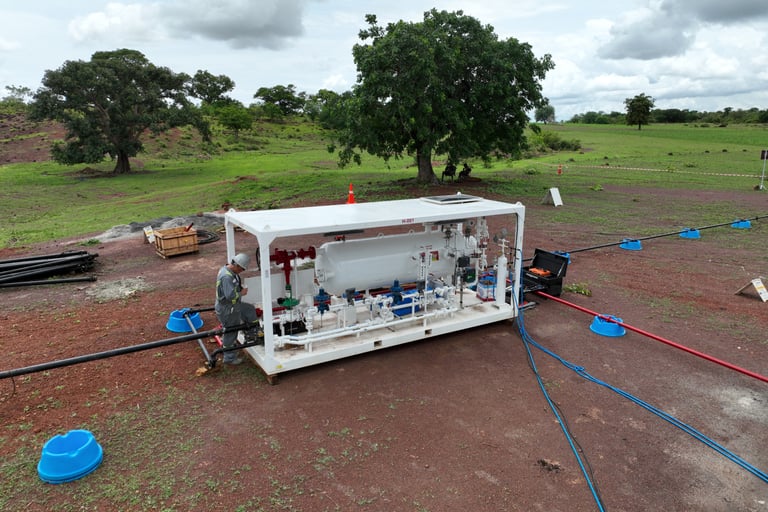
Site of Bourakebougou